This is the latest in our monthly series of Fun Facts about Hunsbury Hill, West Hunsbury, and Northampton generally. To avoid cluttering up our website, we have transferred the first year’s Fun Facts to an Album in our Facebook. If you want to read any of them, here’s a link.
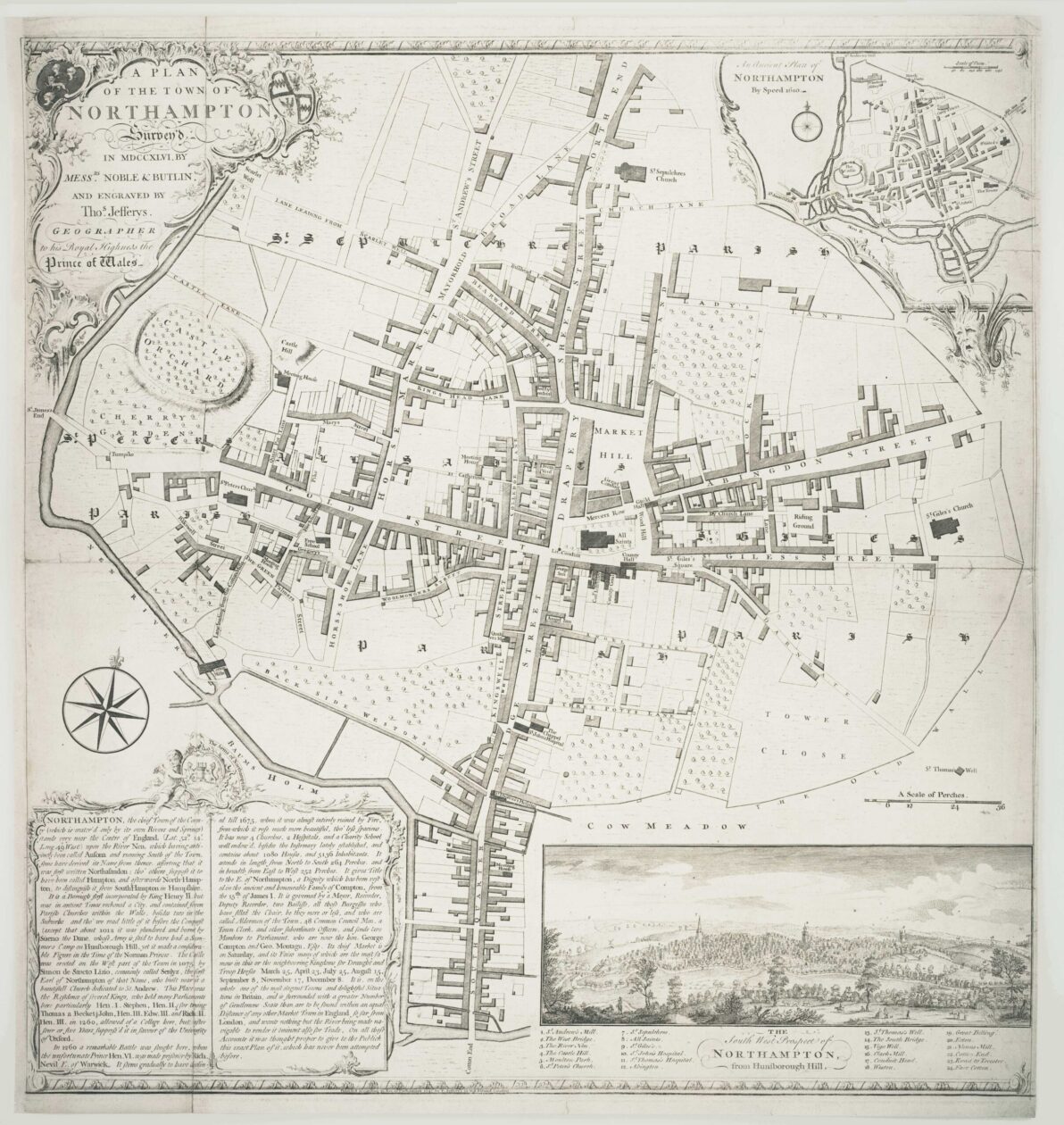
The Noble & Butlin Map of Northampton (1746), which has a sketch of “The South West Prospect of Northampton from Hunsborough (sic) Hill”, also has a dialogue box with a potted history of the town. This states “This Place was the Residence of several Kings, who held many Parliaments here, particularly Henry I, Stephen, Henry II, John, Henry III, Edward III and Richard II“. These monarchs reigned from 1100 to 1399, a span of almost 300 years, although no mention is made of Edward I (1272-1307) and Edward II (1307-1327).
The history of the English Parliament begins in the 13th century, but it grew out of consultative assemblies convened by the earliest English monarchs. In the Anglo-Saxon era*, kings regularly summoned the witan or ‘wise men’ at Christmas, Easter, and Whitsun. While the monarch chose who attended, these gatherings typically included bishops, abbots, ealdormen, and thegns (i.e. substantial landowners).
* The Anglo-Saxon period in Britain spans approximately the six centuries from 410 – 1066 AD (i.e. from the time the Romans left to the Norman invasion), although England itself only came into being during the reign of Alfred The Great’s grandson, Æthelstan (r.924-939).
After the Norman Conquest of 1066, William the Conqueror continued the tradition of summoning assemblies of magnates to consider national affairs, conduct state trials, and make laws. These assemblies were called magnum concilium, which is Latin for Great Council.
Witans, Great Councils and, later, Parliaments, were held in various cities and towns around England, as well as London, at the behest of the monarch. Meetings of the Great Council began to be called Parliament during the reign of Henry III (r. 1216-1272).
The website www.historyofparliamentonline.org has brief details of every Parliament held since 1386, when Parliament met in Westminster, and for the years before that says “Great councils and Parliaments were held (in Northampton) in almost every reign from Henry I’s to that of Richard II“, which supports the Nobel & Butlin map note.
The website then says “(Northampton’s) boundaries were enlarged in 1301, and it began to be chosen as a meeting place for Parliaments, such as those summoned in 1307, 1328, 1331, 1338 and, much later, in November 1380 ….. Northampton was among the earliest towns to receive a summons to Parliament. It did so in 1268; and 15 years later (i.e. 1283) was itself the venue of an assembly of knights, merchants and clergy called by Edward I for counties south of the Trent. As recently as November 1380, a Parliament had been summoned there“. The website implies that 32 Parliaments were held in Northampton.
Within the page for Northampton, Wikipediastates “The castle became an occasional royal residence from the reign of King Henry I in 1130 until that of King Richard II. King John regularly stayed at the castle and moved The Treasury there in 1205. Some 32 Parliaments were held there. The last Parliament at Northampton was held in 1380“.
We do hope you are enjoying our series of Fun Facts. Please keep your comments coming and let us know if you find them interesting.