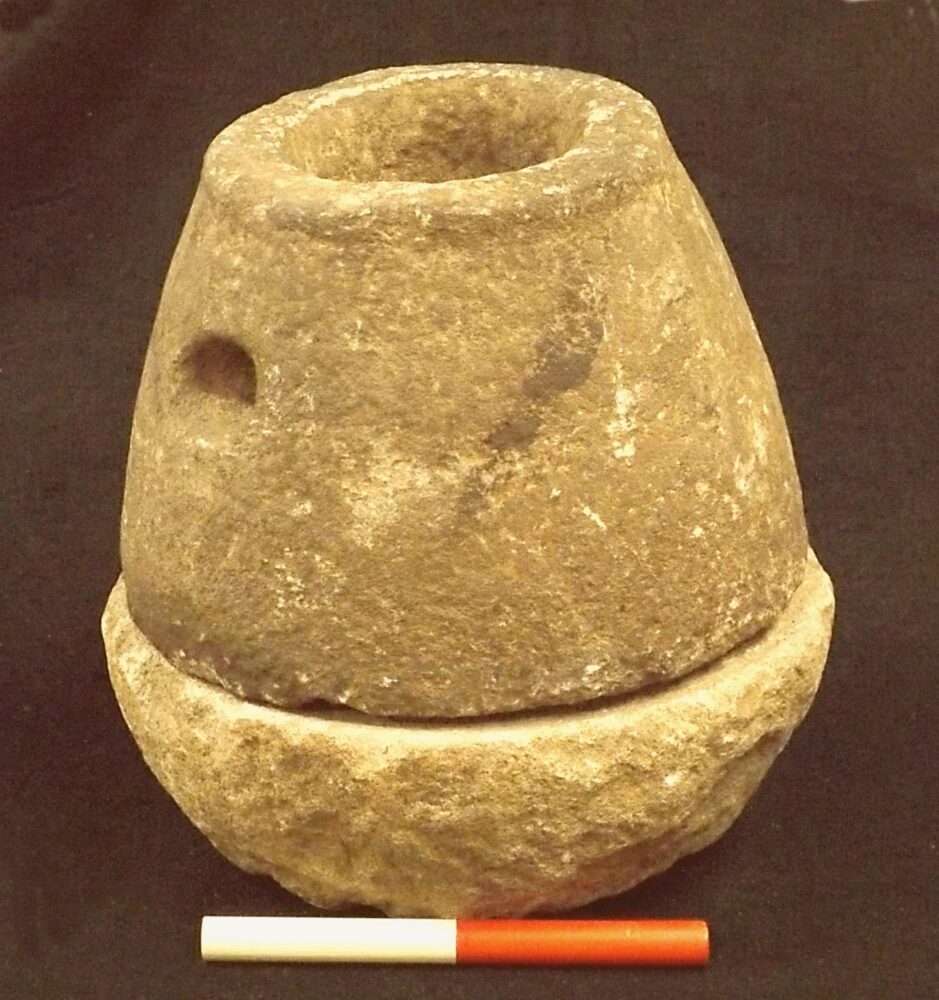
A Hunsbury Rotary Quern (photo courtesy of Andy Chapman)
Hunsbury Hill Iron Age Hillfort is famous (in Iron Age Hillfort and quernstone circles) for having probably the largest collection of rotary querns found in one location. During ironstone quarrying in the late 19th century, over 100, and possibly as many as 159, rotary querns were discovered inside the hillfort, and taken to Northampton Museum. Since then some have reportedly been loaned to the British Museum, but the majority have now been transferred to the Archaeological Research Centre (ARC) in the Chester House Estate, between Wellingborough and Rushden Lakes.
The best known type of the rotary querns found in the hillfort are known as the beehive type, and sufficient of these were found to enable archaeologists to define a Hunsbury-type of beehive rotary quern.
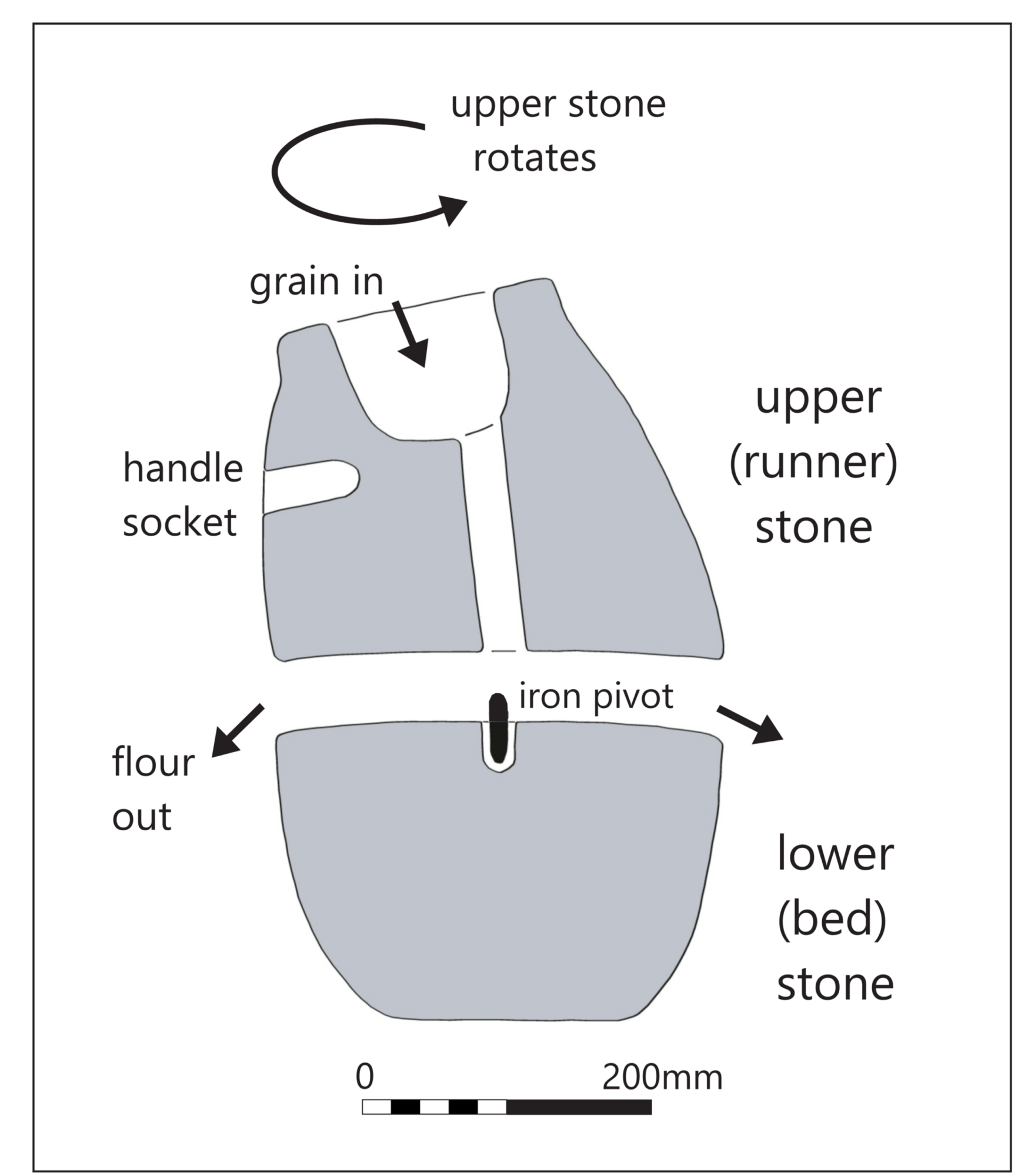
Operation of a rotary quern (courtesy of Andy Chapman)
A rotary quern is a set of stones used to grind cereal grains to make flour, for bread, etc. To operate it, grain would be fed into the hopper at the top of the beehive top section and a wooden rod would be thrust into the socket in the side. The beehive top section would then be rotated or oscillated against the lower section, which would normally be set into the floor, thus grinding the grain into flour with much less effort than needed for saddle querns, which had been in general use everywhere from 4000BC, until the rotary quern replaced them.
The introduction of the rotary quern into Britain during the Middle Iron Age can be placed somewhere between 250-150BC, exactly when Hunsbury Hill Iron Age Hillfort was in full swing. By the Late Iron Age (100BC – 50AD) they were ubiquitous. Rotary querns replaced the saddle quern virtually overnight. They were the Iron Age equivalent of the Air Fryer !
Another interesting fact about the Hunsbury Hill querns is that, because Northamptonshire ironstone is quite soft, they are all made from a harder sandstone, the most popular being Millstone Grit from Derbyshire. This indicates that that Hunsbury was a site of considerable significance, with wide-ranging contacts from Derbyshire to Lincolnshire in the north of England, and to Kent and Sussex in the south.
It has also been suggested that a rotary quern may have been part of a woman’s dowry when she married and, when she died, the upper stone would be deliberately split in two, so no one else could use it.
As a rotary quern set of stones would typically weigh 55-60 kg, they would not be easy to transport, so the fact that so many were gathered together in Hunsbury Hill Iron Age hillfort shows that it was an important centre in the middle of England attracting travellers from all over the country. Indeed, Hunsbury might have been an Iron Age version of a Quernstones -R-Us type of distribution “warehouse”, or even a motorway services type of settlement.
Local archaeologist and historian, Andy Chapman, has recently written an article for the Northamptonshire Heritage Forum’s magazine Hindsight with a spoof sales pitch for Hunsbury Hill’s rotary querns which he has kindly given us permission to replicate here :
Bread for the people: The Iron Age rotary quern
by Andy Chapman BSc MCIfA FSA
Archaeologist, Secretary and Journal Editor,
Northamptonshire Archaeological Society
Hunsbury News 200 BC
Coming soon to a hillfort near you!
Are you facing another winter on your hands and knees slaving over that old saddle quern to put bread on the platter for your family, just like your ancestors did in the days when they were still banging the rocks together?
Slave no more! Using the latest technology from the people who brought you the two-wheeled chariot, we announce the arrival of the Rotary Quern.
Currently in transit from stone quarries in the Peak District, where they’ve been working overtime to meet expected high demand, and soon to arrive in our show roundhouse at Hunsbury Hill. Book your viewing and demonstration NOW. Be the FIRST in your settlement with the latest kitchen accessory, and be the envy of neighbouring roundhouses.
Be amazed at how quickly grain is reduced to flour. Before long, your storage jars will be overflowing, and you’ll be saying, ‘we need a bigger pot’. No more sore knees, no more back strain. Those old saddle querns will only be good for hearth stones.
By Beltane next year, no roundhouse will be complete without one, do YOU want to miss out and be the LAST family in the settlement to have a ROTARY QUERN between your hearth and your vertical warp-weighed loom?
Simple to use, even your children and a feeble slave can now be usefully productive. Easy to use, just follow the instruction diagram, free with each purchase.
And what better dowry could you provide than have your daughter arrive at her husband’s roundhouse and settlement with her personal rotary quern?
To read the full article, please contact us by email (FriendsOWHP@gmamil.com ) so that we can send you a copy.
We hope you found this interesting. Thank you for your comments on our previous Fun Facts. Please keep them coming.