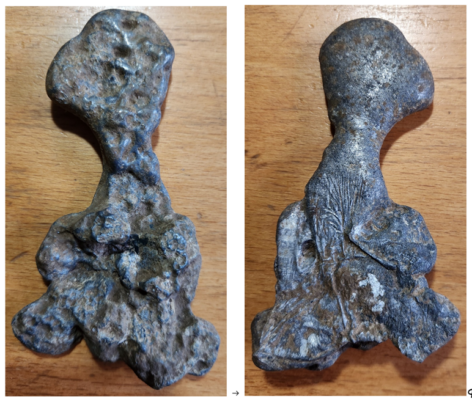
This seemingly insignificant little piece of metal slag, measuring 121mm by 66mm by 18mm thick and weighing 107g, which looks remarkably like an outline of Britain, was picked up by one of the Friends as she walked through Hunsbury Hill Country Park last year (2025).
It was sent away to be officially analysed and the answer came back that it is “an amorphic piece of copper alloy slag of clinker” which dates from circa 100 AD to 1800 AD.
We know that the Iron Age people living in (or using) the Hillfort (circa 500 BC to 50 AD) extracted and smelted the iron ore on Hunsbury Hill, because “a considerable quantity of iron slag was recovered from the camp” (Clare Fell’s comprehensive 1936 paper on the artefacts found in the Hillfort during quarrying in the late 19th century, from ‘The Archaeological Journal, 93:1, 57-100, DOI’).
We also know that the Romans did a lot of smelting and metal working (or at least, supervised it) when they were in Britain (AD 43 to circa AD 410), although not necessarily on Hunsbury Hill.
Although it could be Viking, Anglo-Saxon, or medieval, it is most likely to be Roman in origin ~ and we know there was a Roman presence on Hunsbury Hill due to the villa and bathhouse unearthed in the late 1970’s.
AD 100 is too late for it to be classified as pre-Roman (so it could not have been created by the Iron Age Hillfort peoples) and AD 1800 is too early for it to be resulting from the ironstone ore quarrying (of Hunsbury Hill and the Hillfort) and smelting (at the Briar Hill Blast Furnace at the bottom of the hill by the canal), as the quarrying and smelting only started in 1873.
Although this little lump of slag has no financial value, it is incredible that we can still find such things lying around in the Hillfort and the Country Park in this day and age.
But before you all rush off to the Country Park to find your own little bit of treasure, please remember that the use of metal detectors is not allowed in and around the Hillfort and generally in any of WNC parks without express permission.